Introduction to Arrhythmias
| Author(s) | J.S.S.G. de Jong | |
| Moderator | J.S.S.G. de jong | |
| Supervisor | ||
| some notes about authorship | ||

Arrhythmias (non-normal heart rhythms) can be a challenge to the person who tries to understand them. But with a systematical approach, diagnosis is often less difficult than it seems at the beginning.
Interpretation of the heart rhythm
A good stepwise approach to interprete the heart rhythm is to follow these steps:
- Cherchez le P, French for find the P waves.
- Do you see P waves? Leads II and V1 are often most suitable to find P waves.
- What is the rate of the P waves?
- What is the P wave morphology?
- What is the relationship between P waves and QRS complexes?
- Is every P wave followed by a QRS complex? And every QRS preceded by a P wave? In short: is there a 1:1 relation between P waves and QRS complexes?
- What is the PR interval and does it change?
- What is the ventricular heart rate?
- >100 bpm = tachycardia
- <60 bpm = bradycardia
- are there extra beats? -> Ectopic Beats
- What is the QRS morphology?
- What is the clinical setting?
Secondly it is important to assess the origin of the arrhythmia:
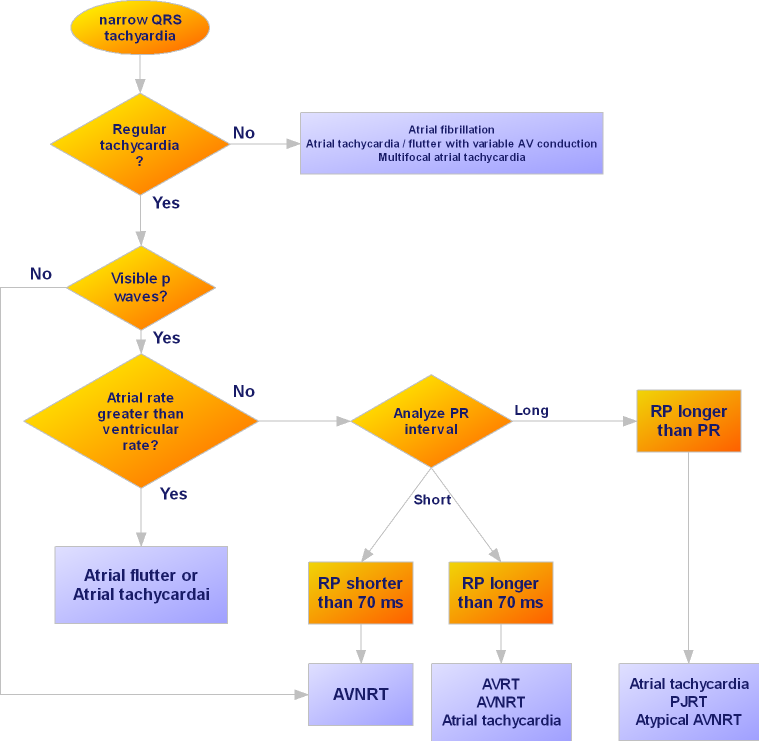
- If the QRS < 120ms (i.e. a narrow complex), then it is either a sinus arrhythmia, supraventricular rhythm or a junctional tachycardia. In tachycardias, this flowchart will lead to the right diagnosis.ESCnarrowQRS
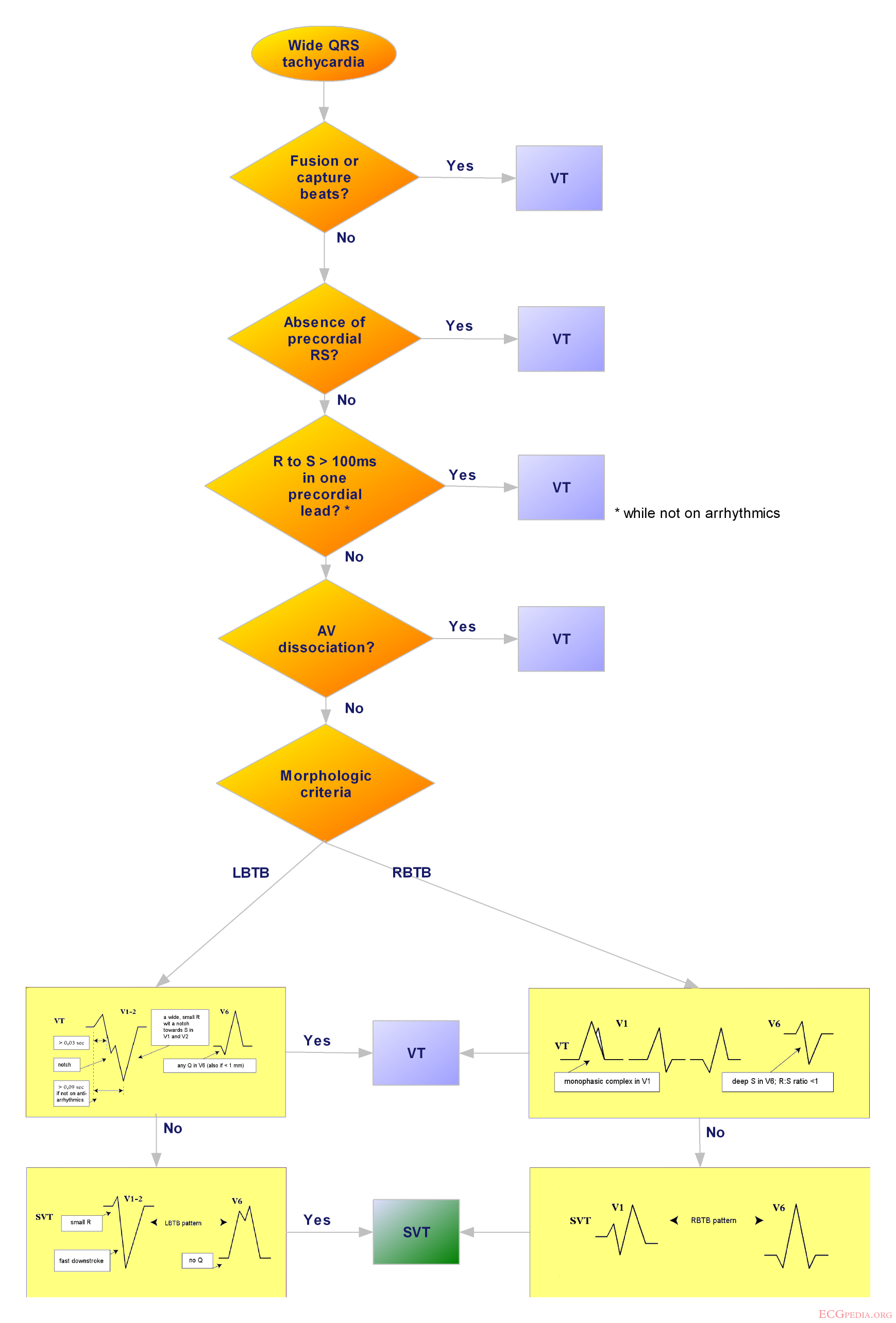
- If the QRS > 120ms it is either a ventricular tachycardia or a supraventricular rhythm with additional bundle branch block. This is a challenging difficulty in arrhythmia diagnosis, therefore a flowchart might help, which incoporates the Brugada criteria for VT.Brugada Another method to discriminate VT from SVT has been proposed by Vereckei et al.vereckei In the editorial on that paper an excellent review is given on the subject by Dendi and Josephson.dendi
References
<biblio>
- ESCnarrowQRS pmid=14563598
- Brugada pmid=2022022
- vereckei pmid=17272358
- dendi pmid=17317697
</biblio>