Introduction to Arrhythmias
Arrhythmias (non-normal heart rhythms) can be a challenge to the person who tries to understand them. But with a systematical approach, diagnosis is often less difficult than it seems at the beginning.
First look at the heart rate:
- >100 bpm = tachycardia
- <60 bpm = bradycardia
- are there extra beats? -> Ectopic Beats
Secondly it is important to assess the origin of the arrhythmia:
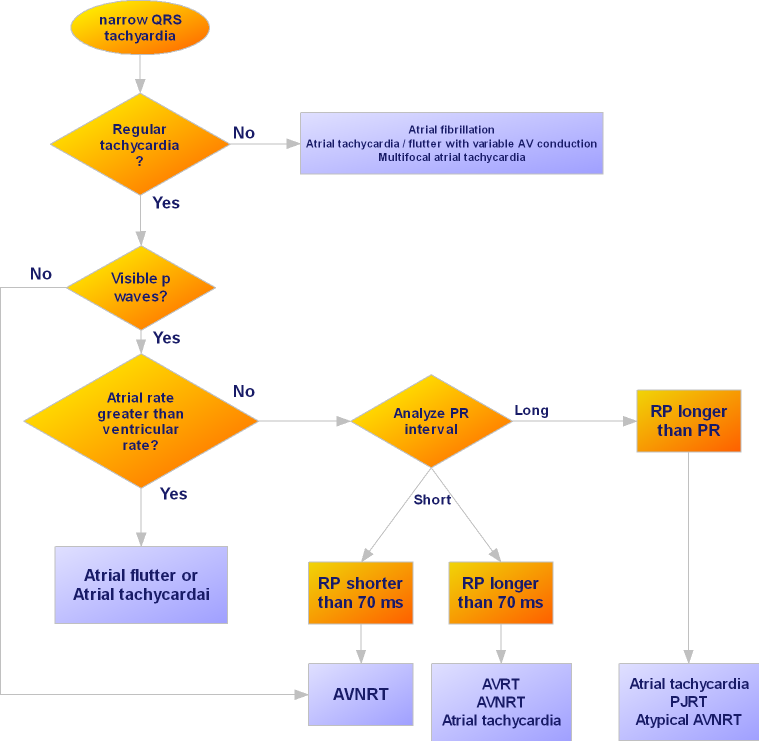
- If the QRS < 120ms (i.e. a narrow complex), then it is either a sinus arrhythmia, supraventricular rhythm or a junctional tachycardia. In tachycardias, this flowchart will lead to the right diagnosis.
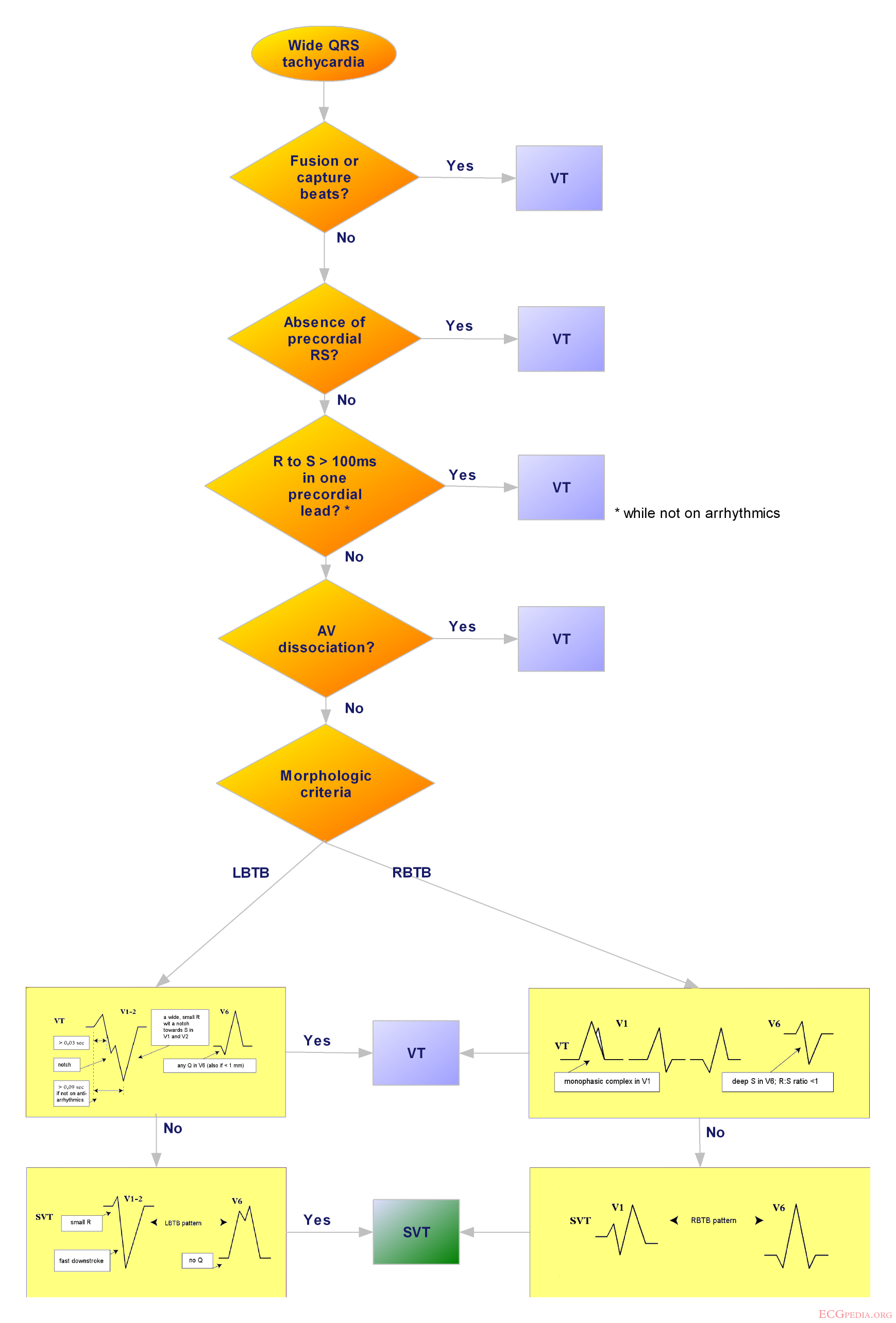
- If the QRS > 120ms it is either a ventricular tachycardia or a supraventricular rhythm with additional bundle branch block. This is a challenging difficulty in arrhythmia diagnosis, therefore a flowchart has been developed for this.brugada
Normal heart rhythm is explained in:
Non-normal heart rhythms (arrhythmias) are described in:
- Supraventricular Rhythms
- Junctional Tachycardias
- Ventricular Arrhythmias
- AV Conduction
- Genetic Arrhythmias
- Pacemaker
- Flowchart: Approach to the Wide Complex Tachycardia
- Flowchart: Approach to the Narrow Complex Tachycardia Adapted from ESCnarrowQRS.
References
<biblio>
- ESCnarrowQRS pmid=14563598
- Brugada pmid=
</biblio>