| Ventricular Fibrillation (VF or V-fib)
|
| {{{locatieafbeelding}}}
|
| Atrial rate |
60-100 bpm
|
| Ventricular rate |
400-600 bpm
|
| Regularity |
irregular
|
| Origin |
ventricles
|
| P-wave |
AV-dissociation
|
| Effect of adenosine |
none
|
| Example ECG: {{{example}}}
|
| Example ECG2: {{{example2}}}
|
Ventricular fibrillation (VF or V-fib) is chaotic depolarisation of the ventricles. Mechanically this results in an arrested cardiac pump function and immediate death. VF can only be treated by immediate defibrillation. If you consider ventricular fibrillation in a conscious patient, than you should look for a technical problem with the ECG, eg. movement or electrical interference.
Examples
-
Ventricular Fibrillation (VF or V-fib)
-
VF develops in a patient with an
inferior MI
-
Seven sinus beats are follow by a ventricular extrasystole (with R on T phenomenon), resulting in ventricular fibrillation
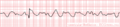 Ventricular Fibrillation (VF or V-fib)
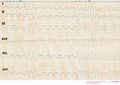 VF develops in a patient with an inferior MI
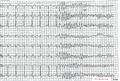 Seven sinus beats are follow by a ventricular extrasystole (with R on T phenomenon), resulting in ventricular fibrillation

