Anterior MI: Difference between revisions
Jump to navigation
Jump to search
mNo edit summary |
mNo edit summary |
||
| Line 6: | Line 6: | ||
[[Image:stroomgebieden.png|thumb| The Left Anterior Descending (LAD) coronary artery is the most important coronary artery. On this mercatorprojection of the heart, the grey area is supplied by blood by the LAD and is at risk if this artery occludes.]] | [[Image:stroomgebieden.png|thumb| The Left Anterior Descending (LAD) coronary artery is the most important coronary artery. On this mercatorprojection of the heart, the grey area is supplied by blood by the LAD and is at risk if this artery occludes.]] | ||
Anterior MI can involve the anterior part of the heart and a part of the ventricular septum. Is supplied by blood by the LAD. Can lead to [[Cardiac Aneurysm|a cardiac aneurysm]] if not treated timely. | Anterior MI can involve the anterior part of the heart and a part of the ventricular septum. Is supplied by blood by the LAD. Can lead to [[Cardiac Aneurysm|a cardiac aneurysm]] if not treated timely. | ||
Proximal or distal occlusion of the LAD can be differentiated when looking at the ST elevation V1-V3 <cite>Zimetbaum</cite> | |||
;Characteristics of proximal LAD occlusion | |||
*ST-segment elevation in V1 (>2.5 mm) or [[RBBB]] with [[Pathologic Q Wave]] or both | |||
*ST-segment depression (>1 mm) in II, III and aVF | |||
;Characteristics of distal LAD occlusion | |||
*Little ST-segment depression (<= 1 mm) or even elevation in II, III, and aVF | |||
Another way to look at this is by assessing the axix of the ST vector. If it points upwards (with ST depression in II, III, and AVF) the proximal LAD is occluded. If it points downwards (with little ST depression or even elevation in II, III, and AVF) the distal LAD is occluded. An ECG that does not show any ST depression sugggests an occlusion after the origin of the first diagonal branch. | |||
{{clr}} | {{clr}} | ||
| Line 19: | Line 29: | ||
<biblio> | <biblio> | ||
#Wung pmid=16777513 | #Wung pmid=16777513 | ||
#Zimetbaum pmid=12621138 | |||
</biblio> | </biblio> | ||
Revision as of 08:47, 25 July 2007
| This is part of: Myocardial Infarction |
ECG-characteristics:Wung
ST-elevation in leads V1-V6, I and aVL. Maximum elevation in V3, maximal depression in III
later: pathological Q-wave in the precordial leads V2 to V4-V5.


Anterior MI can involve the anterior part of the heart and a part of the ventricular septum. Is supplied by blood by the LAD. Can lead to a cardiac aneurysm if not treated timely.
Proximal or distal occlusion of the LAD can be differentiated when looking at the ST elevation V1-V3 Zimetbaum
- Characteristics of proximal LAD occlusion
- ST-segment elevation in V1 (>2.5 mm) or RBBB with Pathologic Q Wave or both
- ST-segment depression (>1 mm) in II, III and aVF
- Characteristics of distal LAD occlusion
- Little ST-segment depression (<= 1 mm) or even elevation in II, III, and aVF
Another way to look at this is by assessing the axix of the ST vector. If it points upwards (with ST depression in II, III, and AVF) the proximal LAD is occluded. If it points downwards (with little ST depression or even elevation in II, III, and AVF) the distal LAD is occluded. An ECG that does not show any ST depression sugggests an occlusion after the origin of the first diagonal branch.
Examples
-
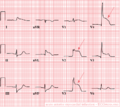 A typical example of an acute anterior wall infarction. ST elevation in leads I, AVL and V2-V5. Reciprocal depressions in the inferior leads (II,III,AVF)
 -
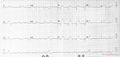 Acute MI with proximal LAD occlusion
 -
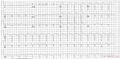 Large acute MI with LAD occlusion
 -
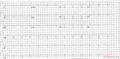 Acute MI with LAD occlusion
 -
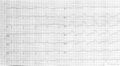 A 2 weeks old anterior infarction with Q waves in V2-V4 and persisting ST elevation, a sign of formation of a cardiac aneurysm.


References
<biblio>
- Wung pmid=16777513
- Zimetbaum pmid=12621138
</biblio>