MI Diagnosis in LBBB or paced rhythm: Difference between revisions
Jump to navigation
Jump to search
mNo edit summary |
mNo edit summary |
||
| Line 1: | Line 1: | ||
In case of a [[Intraventricular Conduction|left bundelbranch block (LBBB)]], infarct diagnostics based on the ECG is difficult. The ST segments are always abnormal in a LBBB, so new ischemia can not be detected. A new LBBB is always pathologocal and can be a sign of myocardial infarction. The criteria (Sgarbossa <cite>LBTB</cite>) that can be used in case of a LBBB and suspicion of infarction are: | |||
*ST elevation > 1mm in leads with a positive QRS complex (concordance in ST deviation) (score 5) | |||
*ST depression > 1 mm in V1-V3 (discordance in ST deviation) (score 3) | |||
*ST elevation > 5 mm in leads with a negative QRS complex (discordance in ST deviation) (score 2) | |||
At a score-sum of 3, these criteria have a specificity of 90% for detecting a myocardial infarction. | |||
{{clr}} | |||
==Examples== | ==Examples== | ||
<gallery> | <gallery> | ||
| Line 4: | Line 11: | ||
Image:MI in LBBB 02.jpg|The same patient as in the first example 2 months before the myocardial infarction. Normal LBBB pattern. | Image:MI in LBBB 02.jpg|The same patient as in the first example 2 months before the myocardial infarction. Normal LBBB pattern. | ||
</gallery> | </gallery> | ||
==References== | |||
<biblio> | |||
#LBTB pmid=11265742 | |||
</biblio> | |||
Revision as of 08:29, 23 July 2007
In case of a left bundelbranch block (LBBB), infarct diagnostics based on the ECG is difficult. The ST segments are always abnormal in a LBBB, so new ischemia can not be detected. A new LBBB is always pathologocal and can be a sign of myocardial infarction. The criteria (Sgarbossa LBTB) that can be used in case of a LBBB and suspicion of infarction are:
- ST elevation > 1mm in leads with a positive QRS complex (concordance in ST deviation) (score 5)
- ST depression > 1 mm in V1-V3 (discordance in ST deviation) (score 3)
- ST elevation > 5 mm in leads with a negative QRS complex (discordance in ST deviation) (score 2)
At a score-sum of 3, these criteria have a specificity of 90% for detecting a myocardial infarction.
Examples
-
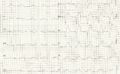 Acute myocardial infarction in in a patient with a pacemaker and LBBB. Concordant ST elevation in V5-V6 are clearly visible.
 -
 The same patient as in the first example 2 months before the myocardial infarction. Normal LBBB pattern.


References
<biblio>
- LBTB pmid=11265742
</biblio>