Electrolyte Disorders: Difference between revisions
Jump to navigation
Jump to search
| Line 29: | Line 29: | ||
Image:KJcasu18-2.jpg|Consecutive ECGs of a patient with hyperkalemia. ECG2 | Image:KJcasu18-2.jpg|Consecutive ECGs of a patient with hyperkalemia. ECG2 | ||
Image:KJcasu18-1.jpg|Consecutive ECGs of a patient with hyperkalemia. After correction of potassium levels. ECG3 | Image:KJcasu18-1.jpg|Consecutive ECGs of a patient with hyperkalemia. After correction of potassium levels. ECG3 | ||
File:DVA0578.jpg|Another patient, potassium of 9. | File:DVA0578.jpg|Another patient, potassium of 9.4 mmol/L | ||
</gallery> | </gallery> | ||
{{clr}} | {{clr}} | ||
Revision as of 19:26, 19 May 2010
| Author(s) | J.S.S.G. de Jong | |
| Moderator | T.T. Keller | |
| Supervisor | ||
| some notes about authorship | ||
Hypercalcemia
Hypercalcemia, high blood calcium, speeds repolarization. Characteristics of hypercalcemia:
- Mild: broad based tall peaking T waves
- Severe: extremely wide QRS, low R wave, disappearance of p waves, tall peaking T waves.
Hypocalcemia
ECG-characteristics of hypocalcemia, low blood calcium:
- Narrowing of the QRS complex
- Reduced PR interval
- T wave flattening and inversion
- Prolongation of the QT-interval
- Prominent U-wave
- Prolonged ST and ST-depression
Hyperkalemia
ECG characteristics of hyperkalemia, high blood potassium:
- Tall peaked T waves
- Flattening p-waves. In extreme hyperkalemia p-waves may disappear altogether.
- Prolonged depolarization leading to QRS widening (nonspecific intraventricular conduction defect) sometimes > 0.20 seconds
At concentrations > 7.5 mmol/L atrial and ventricular fibrillation can occur.
-
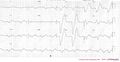 Consecutive ECGs of a patient with hyperkalemia. ECG1
 -
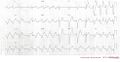 Consecutive ECGs of a patient with hyperkalemia. ECG2
 -
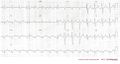 Consecutive ECGs of a patient with hyperkalemia. After correction of potassium levels. ECG3
 -
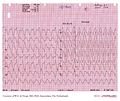 Another patient, potassium of 9.4 mmol/L


Hypokalemia
Hypokalemia, low blood potassium, results in:
- ST depression and flattening of the T wave
- Negative T waves
- A U-wave may be visible
-
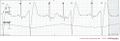 patient A
 -
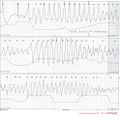 patient A
 -
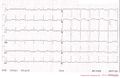 patient B
 -
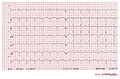 Patient C, Potassiumlevel of 1.5


