Introduction to Arrhythmias: Difference between revisions
Jump to navigation
Jump to search
mNo edit summary |
No edit summary |
||
| Line 1: | Line 1: | ||
{{authors| | |||
|mainauthor= [[user:Drj|J.S.S.G. de Jong]] | |||
|moderator= [[user:Drj|J.S.S.G. de jong]] | |||
|supervisor= | |||
}} | |||
Arrhythmias (non-normal heart rhythms) can be a challenge to the person who tries to understand them. But with a systematical approach, diagnosis is often less difficult than it seems at the beginning. | Arrhythmias (non-normal heart rhythms) can be a challenge to the person who tries to understand them. But with a systematical approach, diagnosis is often less difficult than it seems at the beginning. | ||
Revision as of 22:22, 18 September 2007
| Author(s) | J.S.S.G. de Jong | |
| Moderator | J.S.S.G. de jong | |
| Supervisor | ||
| some notes about authorship | ||
Arrhythmias (non-normal heart rhythms) can be a challenge to the person who tries to understand them. But with a systematical approach, diagnosis is often less difficult than it seems at the beginning.
First look at the heart rate:
- >100 bpm = tachycardia
- <60 bpm = bradycardia
- are there extra beats? -> Ectopic Beats
Secondly it is important to assess the origin of the arrhythmia:
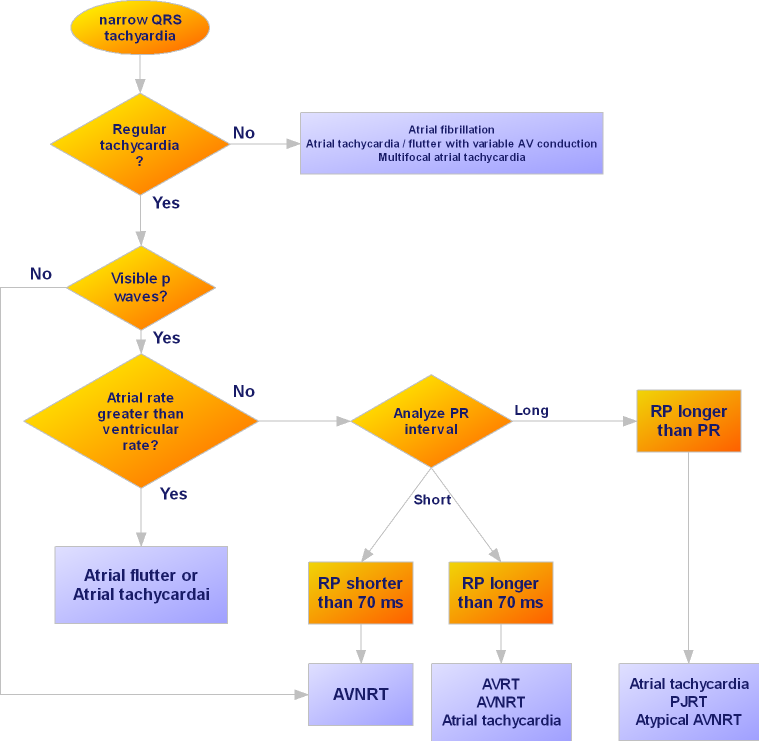
- If the QRS < 120ms (i.e. a narrow complex), then it is either a sinus arrhythmia, supraventricular rhythm or a junctional tachycardia. In tachycardias, this flowchart will lead to the right diagnosis.ESCnarrowQRS
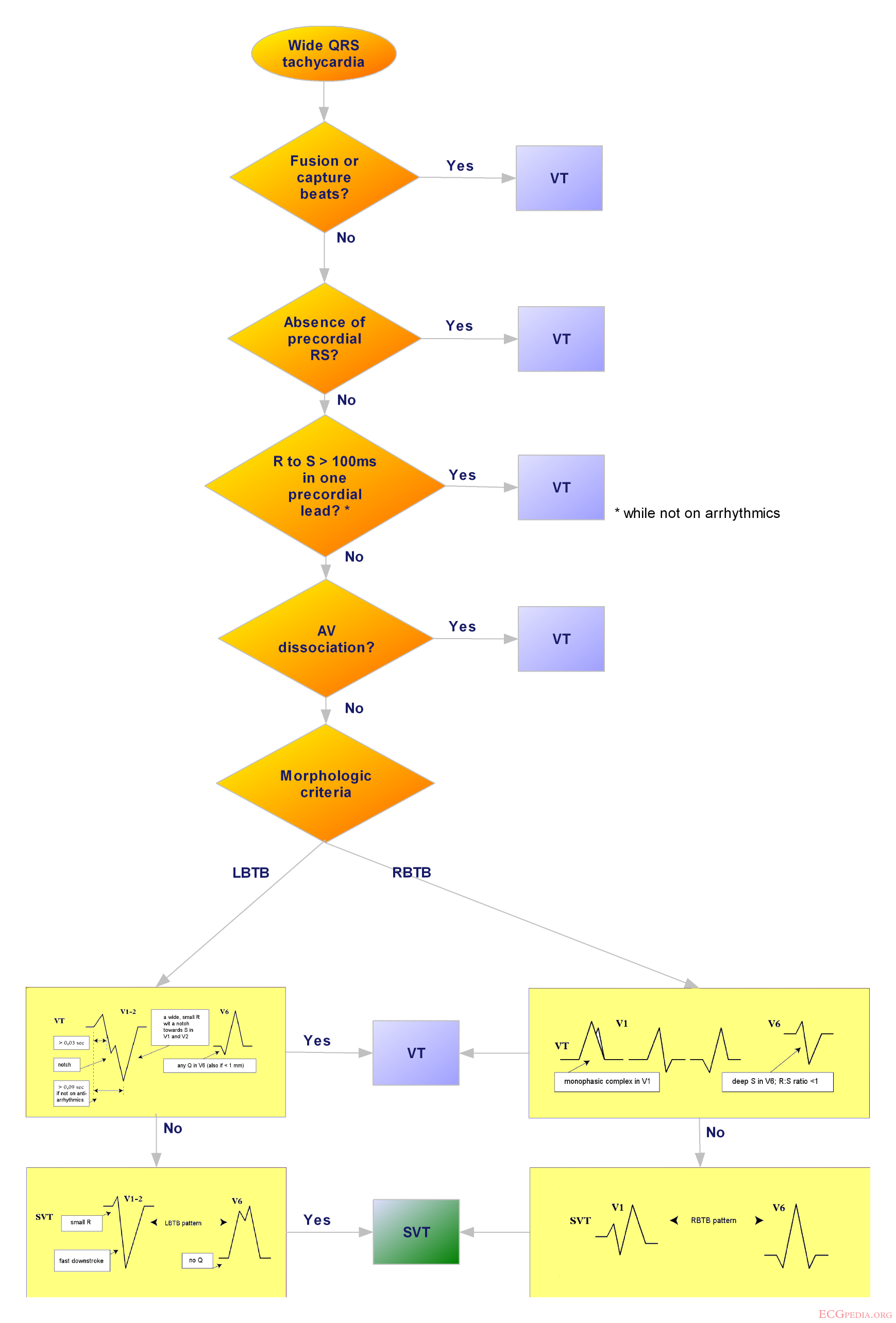
- If the QRS > 120ms it is either a ventricular tachycardia or a supraventricular rhythm with additional bundle branch block. This is a challenging difficulty in arrhythmia diagnosis, therefore a flowchart has been developed for this.brugada
References
<biblio>
- ESCnarrowQRS pmid=14563598
- Brugada pmid=2022022
</biblio>